Borg Design News • November 2018
Precision CNC Machining Behind the Rockefeller Center Christmas Tree Star
High-visibility projects often reveal what precision CNC machining really requires. When Borg Design supported the manufacturing of components used in the Rockefeller Center Christmas Tree star, the challenge was not just producing parts—it was executing complex geometry with consistency, accuracy, and reliability under tight expectations.
For manufacturing engineers and procurement teams, projects like this highlight what separates capable machining partners from general suppliers. The difference is not just equipment. It is how complexity is managed from design through final production.
Why Complex Projects Expose Real Machining Capability
Parts used in highly visible or precision-driven applications introduce a different level of scrutiny. Geometry must be executed exactly as intended. Surface quality, alignment, and dimensional accuracy all play a role in the final outcome.
Unlike standard production parts, there is little room for iteration once manufacturing begins. This requires a machining partner that can interpret design intent, plan for execution, and maintain control throughout the process.
Projects like the Rockefeller Center star are a clear example of how precision machining extends beyond basic part production.
From Design to Execution: Where Challenges Appear
Complex parts often look straightforward in CAD but introduce challenges during machining. Multi-surface features, intricate geometries, and tight tolerances require careful planning before the first cut is made.
Key considerations include tool access, fixturing strategy, and how the part will be machined across multiple setups. Without proper planning, even well-designed parts can lead to inconsistencies or delays.
In high-visibility applications, these risks must be addressed early. There is little tolerance for rework or deviation.
Precision and Repeatability in Complex Geometry
Producing a single part that meets specification is not enough. The ability to execute that part consistently is what defines precision machining.
Complex geometry introduces variability if processes are not tightly controlled. Tool paths, setup alignment, and material behavior all influence the final result. Maintaining consistency requires disciplined programming, stable fixturing, and attention to detail throughout production.
This is especially important when parts must fit together or align visually, as is the case in decorative or structural assemblies like the Rockefeller Center star.
What This Means for Engineers and Procurement Teams
For engineers, projects like this reinforce the importance of working with a supplier that understands both design intent and machining realities. The ability to translate complex geometry into manufacturable parts reduces the risk of redesign and production delays.
For procurement teams, it highlights the value of selecting a supplier based on capability and consistency rather than price alone. High-complexity work requires a level of process control and experience that not all machine shops can provide.
Program success often depends on getting these decisions right early.
How Borg Design Approaches Complex Machining Projects
Borg Design approaches complex machining projects by focusing on alignment between engineering and production. Each project begins with an understanding of the part’s geometry, tolerance requirements, and final application.
From there, machining strategies are developed to ensure accuracy and repeatability. This includes programming, fixturing, and process planning designed to support consistent execution.
With more than 20 CNC machining centers and experience producing complex parts across a range of materials, Borg Design supports projects that require both precision and reliability. The focus is on delivering parts that meet expectations the first time and continue to perform in production.
The Bottom Line
Projects like the Rockefeller Center Christmas Tree star demonstrate what precision CNC machining requires when complexity, visibility, and expectations are high. Success depends on more than equipment—it depends on planning, process control, and the ability to execute consistently.
For engineers and procurement teams, these are the same factors that determine whether a supplier can support critical work without introducing risk.
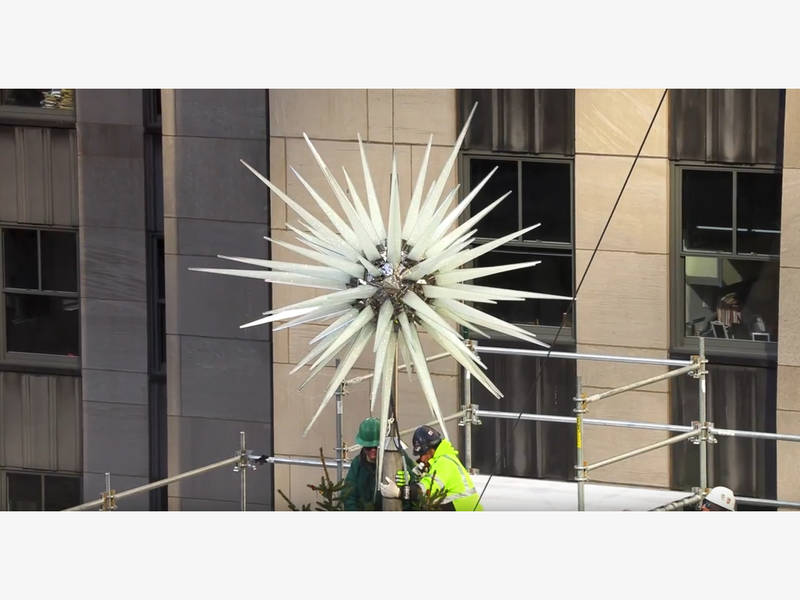
Check out this video of the newly unveiled star for the top of the tree at Rockefeller Center that we were lucky enough to machine components for! Thanks to SWAROVSKI and Orion Red for being an awesome team to work with!
The star was designed by architect Daniel Libeskind and commissioned by Swarovski. In the early spring, Orion Red was asked to build the structure of the star and based on our working relationship they consulted with us to be sure that this was even possible. After many meetings, we were able to assist them in creating this year’s star. At our facility, we made all the mechanical components for the core of the star. Each star consists of 70 core modules. Orion Red then assembled the star with 70 spikes encrusted with over 3 million Swarovski crystals.
Now read the recent article from the Sudbury patch here!
Contact us to discuss your part requirements to see how Borg Design supports complex, precision CNC machining from concept through production.