When 5-Axis CNC Machining Makes Sense

Many parts can be machined successfully on a 3-axis or 4-axis machine. The challenge is knowing when additional capability reduces manufacturing risk and when it adds unnecessary complexity. Our work in defense and aerospace, industrial manufacturing, and medical device part production has led us down a pretty simple path that more is not always better.
When part complexity increases, manufacturing risk often increases with it. More setups, more handling, and more opportunities for variation can all affect quality, lead times, and production consistency. That is where 5-axis machining can make a meaningful difference.
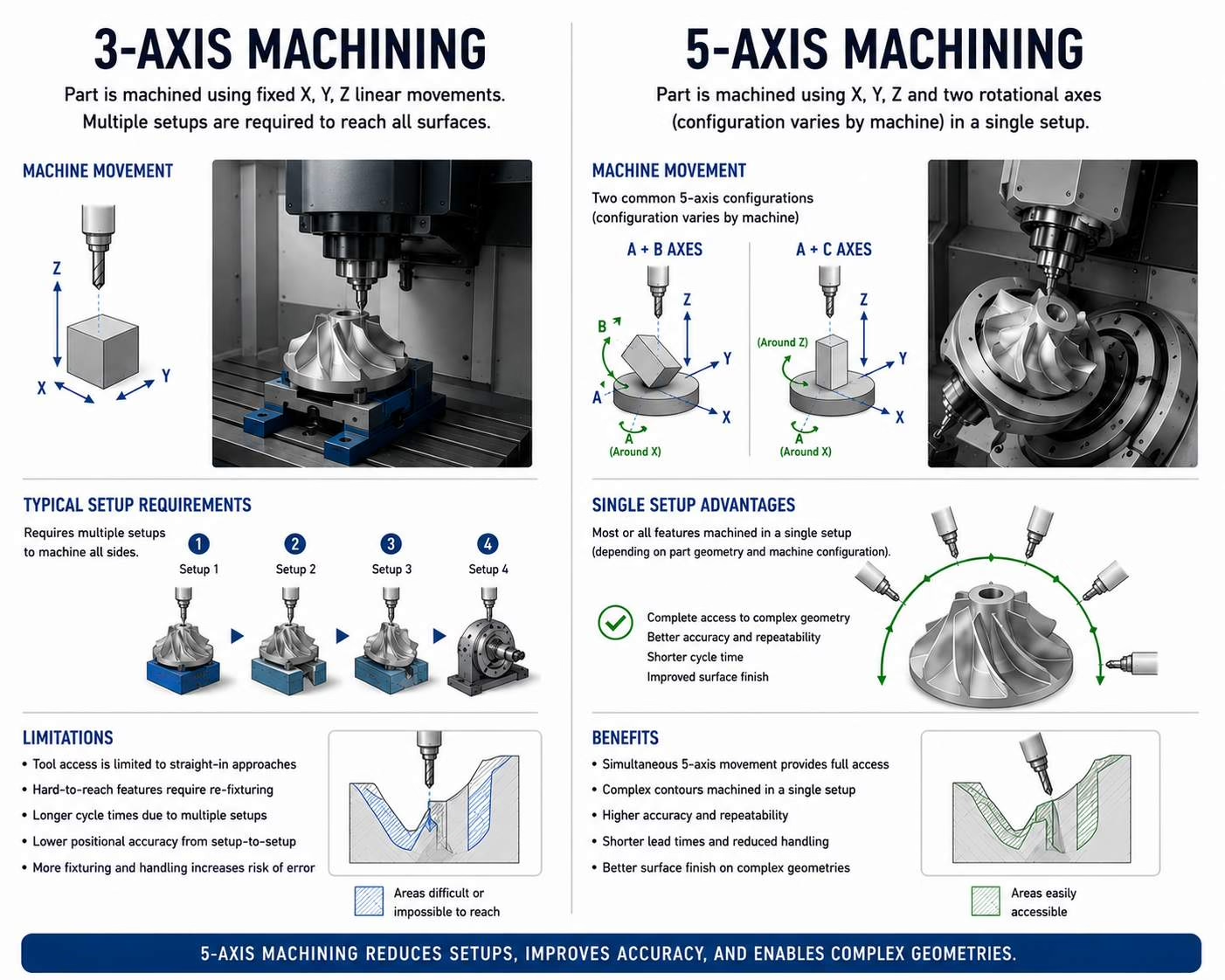
What is 5-axis machining? A machining process that moves cutting tools along five axes simultaneously — three linear and two rotary — enabling complex geometry in fewer setups. Learn more here >>
Not Every Part Needs 5-Axis Machining
For straightforward components with simple geometries, traditional machining methods are often the best choice. Flat surfaces, basic pockets, and easily accessible features can frequently be produced efficiently on 3-axis or 4-axis equipment.
The goal is not to use the most advanced machine available. The goal is to choose the manufacturing approach that delivers the best outcome for the part, the schedule, and the budget.
Sometimes the simplest solution is the right one.
When Part Complexity Changes the Equation
As parts become more complex, manufacturing challenges begin to multiply.
Components with multiple machined faces, compound angles, deep pockets, complex contours, or tight positional relationships between features often require multiple setups using traditional machining methods. Each time a part is repositioned, there is an opportunity for dimensional variation to enter the process.
This is especially common in precision housings, aerospace components, tooling assemblies, and other parts where several critical features must maintain their relationship to a common datum structure.
In these situations, 5-axis machining can often provide a more controlled manufacturing approach.
Setup Reduction Is Often the Real Advantage
When people think about 5-axis machining, they often focus on the machine itself. From a manufacturing perspective, the bigger advantage is usually setup reduction.
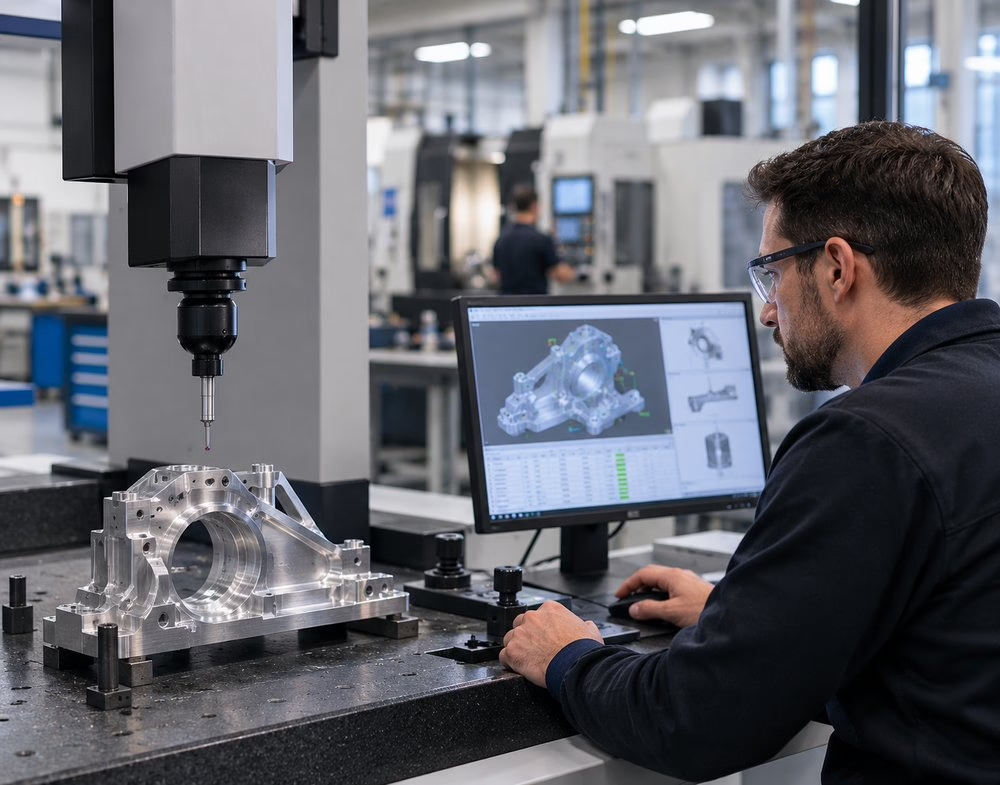
Consider a complex aluminum housing that requires machining on five sides while maintaining tight positional relationships between features. Using conventional methods, that part may require three or four separate setups to complete. With 5-axis machining, the same component is often completed in one or two setups.
Fewer setups often lead to:
- Better feature-to-feature accuracy
- Improved repeatability
- Reduced handling
- More consistent production results
- Lower risk of setup-related variation
For many complex parts, that is where the real value comes from.
What Engineers, Buyers, and Quality Teams Care About
Different stakeholders often evaluate 5-axis machining through different lenses.
Engineers are usually focused on manufacturability, geometry access, and tolerance requirements — particularly how datum structure is maintained across multiple features.
Supply chain professionals are looking for predictable execution, reduced production risk, and confidence that the supplier can support the work without creating schedule problems.
Quality teams are often concerned with repeatability, inspection requirements, traceability, and reducing opportunities for variation between production runs.
While the priorities may differ, all three groups ultimately want the same thing: reliable execution.
Looking Beyond Hourly Machine Rates
One of the most common sourcing mistakes is comparing machining options based only on hourly machine rates.
While 5-axis equipment may cost more to operate, the total manufacturing picture is often different. Fewer setups, reduced handling, improved consistency, and streamlined inspection can all contribute to a more efficient production process.
For complex parts, the lowest machine rate does not always result in the lowest overall manufacturing cost.
The better question is often: which manufacturing approach creates the least risk while producing the best overall outcome?
When to Get a Second Opinion on Your Machining Approach
The decision to use 5-axis machining is rarely about the machine itself. It is about reducing manufacturing risk on complex parts.
If you are evaluating a component and are not sure whether 5-axis machining is necessary, a manufacturability review can help clarify the tradeoffs. An experienced manufacturing team can review the geometry, identify potential production challenges, and recommend the most efficient machining approach before production begins.
Whether the answer is 3-axis, 4-axis, or 5-axis, the goal is the same: produce quality parts efficiently, consistently, and without unnecessary surprises.
Contact Borg Design for a manufacturability review and walk away with a clearer understanding of the production risks, opportunities, and machining options for your part.
Frequently Asked Questions
Q: How do I know if my part requires 5-axis machining?
A: Parts with multiple machined faces, compound angles, complex contours, or tight relationships between critical features often benefit from 5-axis machining. A manufacturability review is usually the fastest way to find out.
Q: Does 5-axis machining always cost more?
A: Not necessarily. While machine rates may be higher, fewer setups and reduced handling can lower overall manufacturing costs for complex parts. Total cost depends on part geometry, setup count, and inspection requirements.
Q: Can 5-axis machining improve part consistency?
A: Yes. Reducing the number of setups helps improve repeatability and maintain tighter relationships between critical features, which reduces variation between production runs.
Q: What types of components benefit most from 5-axis machining?
A: Complex housings, aerospace components, tooling assemblies, precision fixtures, and parts with multi-surface machining requirements are common examples.
Q: Should I redesign a part to avoid 5-axis machining?
A: Not always. A manufacturability review can help determine whether the current design is appropriate or whether design adjustments could simplify production without affecting performance.