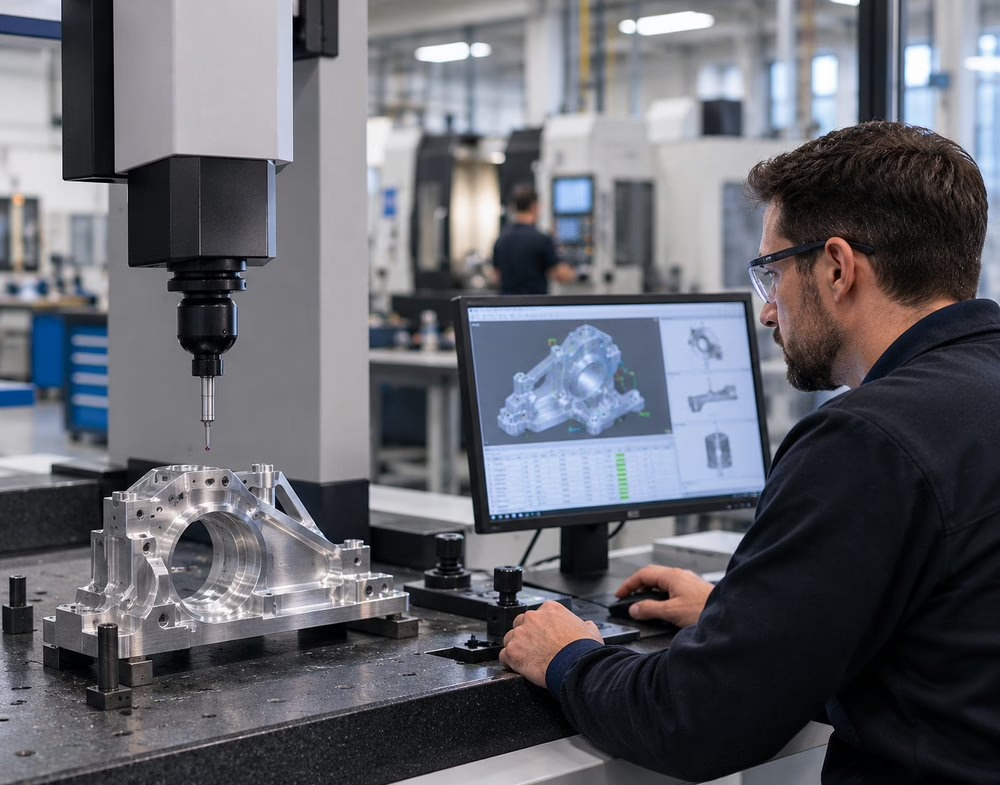
How to Evaluate a Precision CNC Machining Supplier Beyond Price
Engaging in a CNC machining supplier evaluation based on price alone is one of the most common causes of production delays, quality issues, and long-term cost overruns. For procurement teams and manufacturing engineers, the real challenge is identifying a supplier that can deliver consistent results, support engineering requirements, and scale from prototype to production without disruption.
In high-precision industries such as defense, aerospace, medical, and industrial manufacturing, supplier selection directly impacts program success. The difference between a low-cost vendor and a reliable machining partner often becomes clear only after production begins.
 Why Price Alone Is a Poor Indicator of Supplier Value

Initial pricing rarely reflects the total cost of working with a machining supplier. Lower quotes often exclude the operational realities that affect production over time. These can include inconsistent quality, extended lead times, or repeated back-and-forth during part development.
When these issues occur, they create hidden costs in the form of rework, schedule delays, increased oversight, and internal resource strain. Procurement teams may achieve short-term savings but face long-term instability.
Evaluating a supplier requires looking beyond unit price to understand how reliably they can execute.
What Manufacturing Engineers Should Evaluate First
From an engineering perspective, the most important question is whether the supplier can consistently produce the part as designed. This includes their ability to manage tolerances, complex geometries, and material-specific challenges.
Suppliers that lack depth in these areas often rely on repeated adjustments or trial-and-error processes, which slows down production and introduces variability.
Engineers should focus on whether the supplier demonstrates:
- Understanding of part geometry and machining constraints
- Ability to hold tight tolerances consistently
- Experience with relevant materials and surface requirements
- Clear communication during design and production phases
These factors determine whether a part can move smoothly from design to production.
Procurement Considerations That Affect Long-Term Performance
For procurement and supply chain teams, reliability and predictability are critical. A supplier that communicates clearly and delivers consistently reduces the need for constant follow-up and issue management.
Beyond pricing, procurement should evaluate:
- Lead time consistency and schedule adherence, and proactive communication when delays occur
- Responsiveness, and clarity during quoting and production
- Ability to support ongoing production requirements
- Stability of operations and long-term supplier viability
Suppliers that perform well in these areas help reduce risk across the supply chain.
The Importance of Repeatability and Process Control
Producing one acceptable part is not the same as producing that part repeatedly. Repeatability is what separates capable suppliers from those that struggle under production conditions.
Achieving repeatability requires disciplined processes, consistent setups, and controlled machining environments. Without these elements, part quality may vary between batches, even if the initial prototype meets requirements. For quality and program teams, this is where risk becomes visible.
Variability leads to nonconformance, increased inspection requirements, and potential production disruptions. These are unacceptable variables to a successful program.
How Prototype-to-Production Capability Affects Supplier Selection
Many machining suppliers can produce prototypes, but fewer can support a program through full production. This gap often becomes a major issue when a project scales. Suppliers that lack production capability may introduce delays, require design changes, or fail to maintain consistency across larger volumes. Evaluating whether a supplier can support both prototype and production phases is critical. This ensures continuity and reduces the need to transition between vendors mid-program.
However, situations arise all the time that can impact deliverability. Quality of engineering drawings and responsiveness, clarity of volume and expectations, and consistency in communications is a key to partnership and quality. Delays happen. How they are handled together is a true metric of the partnership.
Questions Buyers Should Ask Before Selecting a Supplier
Rather than focusing only on pricing, buyers should ask questions that reveal how a supplier operates under real conditions.
- How do you ensure repeatability across production runs?
- What challenges do you see with this part design?
- How do you handle tight tolerances or complex geometry?
- What happens if issues arise during production?
- What happens if delivery times shift?
- Can you support this part from prototype through full production?
The answers to these questions provide a clearer picture of capability than pricing alone.
How Borg Design Supports Reliable Supplier Performance
Borg Design works with customers to reduce supplier-related risk by focusing on precision, repeatability, and engineering alignment. Projects are supported from early-stage design through production, with an emphasis on clear communication and predictable execution. With over 20 CNC machining centers in a 30,000-square-foot facility in Hudson, Massachusetts, Borg Design supports complex machining requirements across a range of materials, including stainless steel, aluminum, tool steels, titanium, and exotic alloys. Parts are routinely produced to tolerances below 0.0010 inch, with a focus on consistency and quality.
By combining engineering support with production capability, Borg Design helps customers avoid common supplier challenges and maintain stable production outcomes. Partnership with our customers means shared responsibility in quality, communication, and planning.
What’s the Bottom Line?
Completing a CNC machining supplier evaluation requires more than comparing quotes. The ability to produce parts consistently, communicate effectively, and support programs from prototype to production has a far greater impact on long-term success than initial pricing. For engineering, procurement, and program teams, selecting the right supplier reduces risk, improves predictability, and helps ensure that production runs smoothly from start to finish.
Request a quote or discuss your part requirements to evaluate how a precision machining partner can support your project from design through production.
FAQs
What should I look for in a CNC machining supplier?
Focus on repeatability, engineering support, communication, and the ability to handle complex parts—not just pricing.
Why is the lowest quote not always the best option?
Lower pricing can lead to hidden costs such as delays, rework, and inconsistent quality during production.
How can I evaluate machining capability?
Ask about tolerances, materials, repeatability, and how the supplier handles complex geometries and production scaling.
What role does engineering support play?
Early engineering input helps improve manufacturability and reduces production risk.
Can one supplier handle both prototype and production?
Some can, but it is important to confirm this capability to avoid disruptions when scaling.